
Why Your Confidence Drops When You Try Something New
Feb 04, 2026
Most therapists don’t struggle with confidence in the therapy room.
You’ve earned that confidence the long way. Training. Supervision. Mistakes. Years of sitting with real people and real pain.
But the moment you step into something adjacent, such as teaching, creating a course, writing, or speaking, that confidence can wobble.
Not because you’re incapable.
Because suddenly, you’re a beginner again.
If that’s you, I want you to know something up front: nothing has gone wrong.
Why Being a Beginner Again Feels Like Failure (Even When It Isn’t)
When you try something you didn’t train eight to ten years to do, your brain fills in the gap with judgment.
I should be better at this by now.
Maybe this isn’t for me.
I should go back to what’s safe.
But that voice isn’t evidence.
It’s discomfort.
Think about how you work with clients. You don’t interpret awkward first steps as failure. You see them as part of growth.
Yet when it comes to your own work, you expect perfection on the first attempt.
That’s like standing at the base of a mountain and criticizing yourself for not already being at the top.
Small takeaway:
Name beginner discomfort for what it is. Don’t let it masquerade as a verdict on your ability.

The Quiet Way Most Therapists Lose Confidence
Most people don’t quit loudly.
They quit quietly.
They post once.
They share an idea.
They send an email.
Nothing obvious happens.
So they tell themselves, I’ll come back to this later.
And later quietly becomes never.
The brain prefers safety. Familiarity. Known outcomes.
So it nudges you back toward what feels secure, even if it’s not what you actually want.
This is how momentum is lost. Not through dramatic failure, but through silent retreat.
It’s like turning back on a hike not because the path is wrong, but because the climb feels harder than expected.
Small takeaway:
Notice when “I’ll do this later” is really fear asking to stay comfortable.

Confidence Grows on Evidence, Not Feelings
We often think confidence means believing in yourself harder.
But grounded confidence is different.
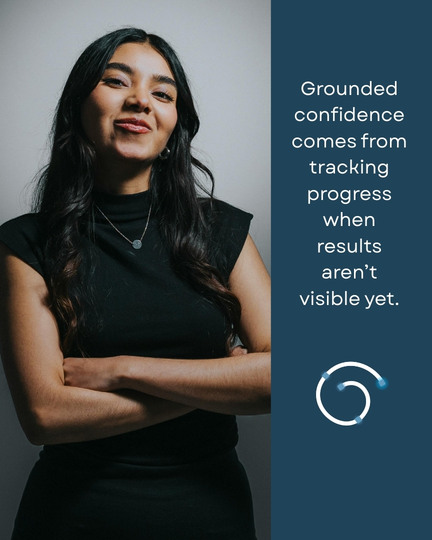
It’s believing you’re walking in the right direction, even when the results aren’t visible yet.
Confidence has two parts:
- Your confidence in yourself
- Other people’s confidence in your work
Those two feed each other. When feedback is missing, your mind fills the silence with doubt.
That’s why proof matters.
Proof isn’t hype.
It isn’t bragging.
It’s evidence.
It’s what real people say when something you created helped them.
It’s what they do differently because of your insight.
Most therapists already have this proof. They just don’t treat it like proof.
Years of experience get dismissed as “common sense.”
Full schedules get waved off.
Insight gets minimized.
But distilled wisdom only looks obvious to the person who earned it.
Small takeaway:
Start treating your experience like experience. It counts, even if it feels ordinary to you.

How to Ask for Feedback Without Crossing Ethical Lines
Many therapists avoid collecting proof because they want to stay ethical, and that’s good.
Ethical practice matters.
The key distinction is this:
Once a client, always a client.
So you don’t ask patients for testimonials.
But you can ask:
- Students who took a course
- Attendees of a workshop or webinar
- Readers of your book
- Colleagues or peers
- Members of the general public who engaged with your educational work
You’re not asking for praise.
You’re asking for perspective.
Four simple questions work well:
- What were you struggling with before this?
- What made you decide to try it?
- What changed for you?
- How would you describe this to someone on the fence?
That’s not pressure.
That’s data.
It’s like checking trail markers on a hike. You’re confirming you’re still on the path.
Small takeaway:
Send one email. Ask four questions. Save the responses. Let the evidence speak.
Where This Proof Belongs When Doubt Shows Up
Proof has three homes.
First, it belongs on your page.
Not as a résumé, but as reassurance. People are asking, Does this person get me? Can they help someone like me?
Second, it belongs in your emails.
Sprinkled in. Human. Relatable. Never forced.
And third, and this matters more than we admit, it belongs in your heart and mind.
Entrepreneurship is hard. Teaching is vulnerable.
There will be days when emotions run low.
Proof becomes something solid to stand on when feelings fade.
It’s like seeing a sign on the trail that says, Two miles to the summit.
You’re not there yet, but you know you’re not lost.
Small takeaway:
Create a simple folder for feedback and return to it on hard days.

A Closing Reflection
You don’t need more confidence to move forward.
You need better evidence.
You are probably further along than you believe.
And the work you’re doing now—quiet, imperfect, unseen—is preparing you for views you can’t see yet.
If you want help with this next step, I’ve linked the podcast episode and a simple handout in the show notes that walks you through collecting proof in an ethical, grounded way.
One email. One step. One sign that you’re still on the path.
Links and Resources
- STP 147 Resource - Great Testimonials - 4 questions that get great testimonials every time
- Visit Course Creation Studio to explore tools and support for building educational offers
- Explore ScalingTherapistServices.com for resources designed specifically for therapists growing beyond the therapy room
- Message me on LinkedIn - I am always looking to help people put their mission in motion.
15 Ways To Create Income Flow from What You Already Know
Subscription give you weekly updates on blogs, podcasts, webinars, and offers from CCS and their partners. We hate SPAM. We will never sell your information, for any reason.
